






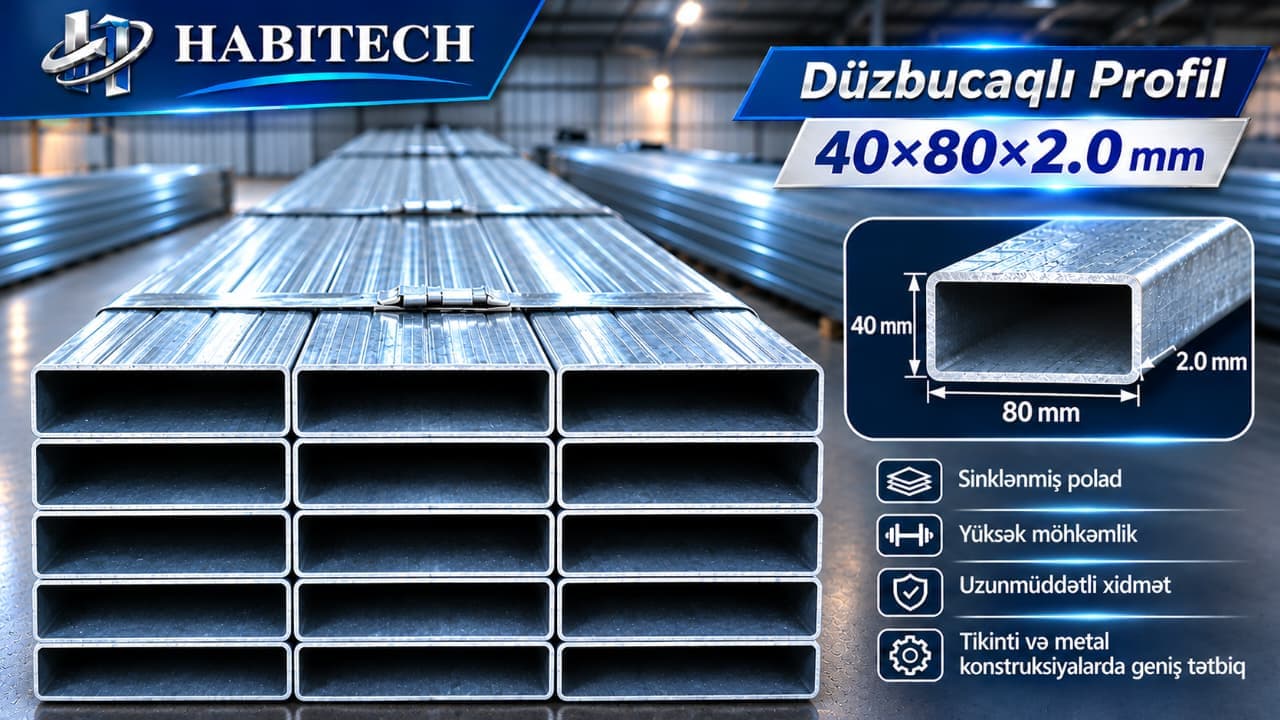
Sinklenmis polad profilleri
WholesaleNegotiable
Retail11 manat
Min. orderNegotiable
BakuYesterday, 05:47
Steel angles and channels wholesale in Azerbaijan runs through local rolling plants and import traders, stockists with yards around Baku, Sumgait and Ganja, and smaller depots that sell single bars to walk-in trade. The buyers are steel fabricators erecting warehouses, hangars and mezzanine floors, contractors who need lintels, stair stringers and canopy frames, and workshops welding gates, fences, trailers and greenhouse arches.
Sections are priced by the tonne and counted by the bar. Stock bars are commonly 6 m or about 12 m long, and the length decides the vehicle: short bars fit a flatbed truck, long ones need a trailer and a crane at unloading. Size notation differs by type: a hot-rolled channel carries a number equal to its web height in centimetres under the post-Soviet GOST convention, an angle is given as leg × leg × thickness in millimetres, and a hollow section as side × side × wall. Price follows the steel grade, the thickness, whether the bar is hot-rolled or cold-formed, black or galvanised, and the size of the order.
The city filter matters more for steel sections than for most goods, because hauling 12 m bars across the country can outweigh the gap between two quotes. Switch the offer type to buy requests to see which fabricators are looking for a given channel number or hollow-section size. Each product page shows the minimum order with its unit, tonne, metre or piece, and a wholesale price where the seller entered one. Cutting, loading and transport are settled with the seller directly.
Before paying for a full load, measure a few bars with a caliper and weigh a one-metre offcut. Sections rolled at the lower limit of the thickness tolerance give more metres per tonne but less steel in every metre, which matters when the engineer's calculation assumed the nominal size. Then match the heat number on the bundle tag to the mill certificate.
A steel section is ordered by its designation, and each type has its own. For hot-rolled channels and I-beams the post-Soviet GOST convention uses a number equal to the height in centimetres, so the number alone says nothing about flange width or weight per metre; those come from the tables of the standard. Angles and hollow sections are written out in millimetres: leg × leg × thickness for an angle, side × side × wall for a square or rectangular section.
The mill certificate and the bundle tag repeat the designation together with the steel grade and the heat number. Check the size with a caliper on arrival, since thickness is the dimension most affected by rolling tolerances and by substitutions. The table shows how each section type is written.
| Section | How the size is written | Example |
|---|---|---|
| Hot-rolled channel | number = web height in cm; letter for flange shape | No. 12P: 120 mm web, parallel flanges |
| Equal angle | leg × leg × thickness, mm | 50×50×5 |
| Unequal angle | long leg × short leg × thickness, mm | 100×63×8 |
| Square or rectangular hollow section | side × side × wall, mm | 40×40×2; 60×40×3 |
| I-beam | number = height in cm; series letter where used | No. 20: 200 mm high |
| Cold-formed channel | height × flange × thickness, mm | 100×50×3 |
Last updated:
The number of a hot-rolled channel is its web height in centimetres, so a No. 12 channel is 120 mm high and a No. 20 is 200 mm. This is the post-Soviet convention of GOST 8240, and a letter after the number shows the flange shape: U for flanges with an inner slope, P for parallel flanges. Cold-formed channels bent from strip are written in full instead, as height × flange × thickness in millimetres.
An angle, sold in trade English as steel angle or angle iron, is specified by its two leg widths and its thickness in millimetres: 50×50×5 is an equal angle with 50 mm legs and a 5 mm thickness, and 100×63×8 is an unequal one. Add the steel grade, the bar length and the tonnage or the number of bars. Sellers in the region also quote an angle by number, meaning the leg width in centimetres, so confirm the thickness separately, because one number covers several thicknesses.
Both: in steel angles and channels wholesale, importers and stockists quote by the tonne, while smaller yards also sell by the metre or the single bar. Converting one into the other uses the theoretical weight per metre given in the standard for each size, and the real figure drifts within the rolling tolerance. Check the unit beside the minimum order on the product page, and ask whether the invoice will follow theoretical weight or the weighbridge ticket.
Most sections are stocked as 6 m bars and as bars of about 12 m, with hollow sections and light angles more often in the shorter length. Some sellers supply random lengths within a stated range and quote them differently from exact lengths. Cutting to a list depends on the yard: ask whether it has a band saw or only a gas torch, how offcuts are charged and whether cut pieces come bundled and marked.
A hot-rolled section is shaped from a heated billet between rolls, which gives it a thick root, a sharp outer corner and the stiffness needed in load-bearing frames. A cold-formed section is bent from flat strip, so its thickness is the same all round, its corners are rounded and it weighs less per metre. Cold-formed angles and channels suit racking, cladding rails and light frames; for columns and main beams the designer normally specifies hot-rolled steel.
The mill certificate should show the steel grade, the heat number, the chemical composition, the yield and tensile strength, the standard the section was rolled to and its size. Grades such as St3, S235 and S355 are common on structural sections, and the project drawings say which one is required. Compare the heat number on the certificate with the tag or paint mark on the bundle, since a certificate that cannot be tied to the bars says nothing about them.
Workshops that make gates, fences and greenhouse frames mainly buy light hollow sections, for example 20×20, 40×20 and 60×40 mm with walls of 1.5 to 3 mm, plus small equal angles for frames and brackets. Heavy channels and I-beams go to fabricators of building frames, mezzanines and crane runways. A workshop order is therefore many bars in a few light sizes, which smaller yards are willing to sell by the bar.
An I-beam number is also the nominal section height in centimetres, but a series letter is added for beams with parallel flanges. In the post-Soviet system B marks a normal beam, Sh a wide-flange beam and K a column section, while European tables use IPE and HE names for comparable shapes. Two beams of the same height can differ widely in flange width and weight per metre, so order by the full designation on the drawing and never by height alone.
Store sections on timber bearers clear of the ground, sorted by size and laid with a slight slope so that rainwater runs out of channels and hollow sections. Black steel picks up surface rust quickly in the humid, salty air of the Caspian coast, so use the oldest bundles first or keep them under a roof. Galvanised bars are stacked with spacers and kept dry, because water trapped between zinc surfaces leaves white stains.
Yes, a buy request is free to post, and sellers who hold the size contact you directly. Write the section type and size in full, for example channel No. 16 or angle 63×63×6, then the steel grade, the bar length, the tonnage and the city where the steel is needed. Product pages on the platform are written in Azerbaijani, so adding the local words «şveller» for channel and «künc» for angle helps yards find the request.