



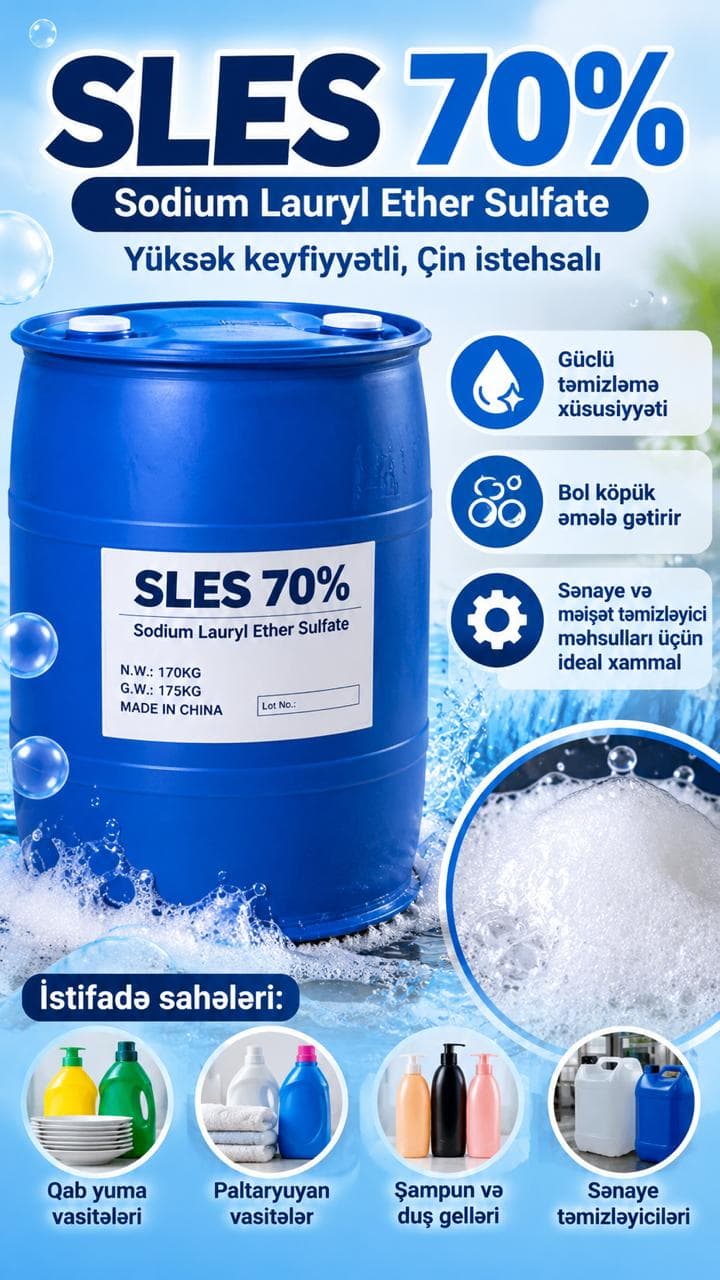
Yuyucu madə - xanmal
Wholesale833 manat
Retail833 manat
Min. order1 Piece
BakuYesterday, 05:48
Industrial chemicals wholesale in Azerbaijan is a business-to-business trade on both sides. Importers, distributors and local producers, many around Baku and Sumgait, supply oilfield service companies, water-treatment plants and pool operators, food factories, textile and leather processors, metal finishers, and makers of paint, plastics and detergents. An order starts from a specification and not from a product name: concentration, purity grade, moisture and permitted impurities.
Solids such as caustic soda flakes or soda ash come in 25 kg bags; liquids such as acids, solvents and hypochlorite come in canisters of 20 to 30 litres, drums of about 200 litres and 1,000 litre IBC totes, and bulk volumes travel by road tanker. Minimums often start at one bag or one drum, though some imported lines sell only by the pallet or the tonne. Price is set first by the grade, technical, food or reagent, then by raw-material markets, the exchange rate, packaging and the cost of carrying hazardous freight. Pool and water-treatment chemicals sell mostly before and during summer, de-icing salts in winter.
A plant buyer can narrow this page by city to find warehouses near the production site, then by offer type to separate offers from buy requests. The unit beside the minimum order, kilogram, litre, barrel or tonne, shows whether a lot matches monthly consumption. Sellers who entered a price show it per unit; others quote once they know the grade and volume. Recurring demand, for example monthly hypochlorite for a water plant, can be posted as a buy request.
For every batch, ask for the safety data sheet and the certificate of analysis, and check that the batch number on the label matches both. Trade, storage or transport of some substances may require a permit or licence, so confirm with the seller which documents apply. Before a new supplier's product goes into the process, test a sample in a laboratory against the certificate.
Industrial chemicals reach the buyer in a handful of standard packs, and the pack decides the minimum lot, the handling equipment and the storage space. Liquids go into canisters for manual dosing, drums for forklift handling and IBC totes with a bottom valve for plants that pump straight from the container; solids go into lined bags stacked on pallets or into big bags lifted by their loops.
Whatever the pack, its label repeats the concentration or grade, the batch number and the hazard pictograms, and these should agree with what is written in the safety data sheet and the certificate of analysis. A reused container deserves a question about its previous contents. The table gives the usual size of each chemical pack and the first things to inspect on delivery.
| Pack | Usual size | What to inspect on delivery |
|---|---|---|
| Canister | 20–30 L | cap seal intact; label legible; no swelling |
| Drum, plastic or steel | about 200 L | bungs sealed; drum material suits the contents; dents and rust |
| IBC tote | 1,000 L | valve and cage; new or reconditioned; previous contents |
| Bag with inner liner | 25 kg | liner untorn; no caking or damp; production date |
| Big bag | 500–1,000 kg | lifting loops; discharge spout; pallet condition |
| Road tanker | by the tonne | seals on the hatches; weighbridge ticket; tank cleaning record |
Last updated:
Caustic soda is sold as solid flakes or pearls in 25 kg bags and big bags, and as a liquid solution in canisters, drums, IBC totes or road tankers. The solid form is easier to store and to ship in small lots, while the liquid suits plants that dose it straight from a tank. Flakes draw moisture from the air and cake, so bags must stay sealed, and the label states the concentration, the grade and the batch number.
Often yes: many chemicals wholesale suppliers sell from one 25 kg bag, one canister or one drum, while importers of some lines sell only by the full pallet, IBC tote or tonne. The product page shows the minimum order with its unit, so compare it with your monthly consumption and with the shelf life of the product. Buying a year's supply of a solution that weakens in storage, such as hypochlorite, saves nothing.
The grade states how pure a product is and what it may be used for: technical grade serves general industrial processes, food grade serves food and drink production, and reagent grade serves laboratory analysis. Each grade has its own impurity limits, reported in the certificate of analysis. On laboratory reagents of post-Soviet origin the label may carry purity marks that translate as pure, pure for analysis and chemically pure, in rising order of purity.
Acids and alkalis are normally packed in polyethylene canisters, drums and IBC totes, while many solvents are packed in steel drums because they soften or permeate some plastics. The container has to resist its contents, as a corrosive liquid in the wrong drum can leak on the road. Check that caps and bungs are sealed, that the pack carries a UN approval mark for dangerous goods, and whether an IBC tote is new or reconditioned and what it held before.
Read the product name, the concentration or grade, the net quantity, the batch number, the producer and the hazard pictograms with their signal word. Goods classed as dangerous for transport also show a four-digit UN number and a diamond-shaped class label. Compare all of this with the safety data sheet, and turn away packs whose labels are missing, written over by hand or in a language nobody at your site can read.
Pool chemicals should be stored dry, cool and ventilated, with chlorine products kept well apart from acids, because contact between them releases toxic chlorine gas. Different chlorine products, such as calcium hypochlorite granules and stabilised chlorine tablets, should not be mixed or stored loose together either. Liquid sodium hypochlorite loses strength with heat, light and time, so check the production date on the canister and buy what one season will use.
Flammable solvents such as acetone, toluene and white spirit are kept in closed drums in a ventilated place, away from heat, sparks and oxidisers. Their flash point and hazard class are given in the safety data sheet, which also describes fire-fighting measures and spill response. Carrying larger quantities may require a vehicle and driver equipped for dangerous goods, so settle with the seller who arranges transport and under which documents.
Some substances may need a licence, registration or an end-use declaration, and the list depends on the product and the country. Certain acids and solvents are treated in many jurisdictions as controlled precursors, strong oxidisers and toxic substances can have rules of their own, and the transport of dangerous goods has separate requirements. Ask the seller which documents apply to the acid, solvent or oxidiser you are buying, check that they are valid and keep copies with the batch records.
Prices follow world raw-material and energy markets, the exchange rate and freight, with seasonal demand on top. Solvents track oil-based feedstocks, caustic soda and chlorine products come from electricity-hungry production, and pool and water-treatment chemicals are wanted before and during summer. Sellers therefore tend to keep a quote open for a short period, and regular buyers often agree in advance how the price will be reviewed.
State the product by its chemical name, then the grade, the concentration, the packaging, the quantity per delivery and per month, and the city. Posting a buy request is free, and suppliers who can meet the grade contact you directly. Product pages on the platform are written in Azerbaijani, so adding the local trade name, for example «kaustik soda», helps sellers recognise the product; the platform does not check goods or take part in the deal.